
SLP or Tutor for Reading: Why a Language-Based Approach Matters

Watching your child struggle with reading is one of the hardest parts of parenting. You see them hesitate over words, avoid books, and lose the confidence they once had. Your first instinct might be to find a tutor, and that can be a helpful step. But tutoring does not always address the real problem. The choice between an SLP vs tutor for reading depends on why your child is struggling. When reading difficulties are rooted in language, a speech-language pathologist may be the professional your child truly needs.
What Reading Tutors Typically Do
Reading tutors focus primarily on reading instruction. They are a strong fit when a child understands the concepts but needs more time and repetition to master them. A tutor provides structured practice and reinforcement of skills that have already been taught in the classroom. Sessions often include re-reading leveled books and chapter texts, practicing comprehension questions and summarizing, homework help and study strategies, and general phonics reinforcement tied to the school curriculum.
Tutoring works best when there is a gap between what a child has learned and what they can do independently. If your child keeps up with lessons but needs extra repetitions to build fluency, a tutor can provide that support. Choose a reading tutor when your child needs more practice with classroom material and study skills.
What Speech-Language Pathologists Bring to Reading
Speech-language pathologists have a broader scope than reading tutors. A tutor teaches academic content, while an SLP addresses the underlying language and communication skills that make learning possible. SLPs are trained in phonology, morphology, and the way language is structured and processed. These are the same systems children rely on when they decode words, spell, and understand sentences.
Written language abilities clearly fall within an SLP's scope of practice. Many SLPs also receive additional training in reading, spelling, and writing so they can specialize in literacy and dyslexia. That training changes the nature of the work: an SLP provides therapy, not just instruction. Rather than re-teaching a missed lesson, the SLP identifies the language processes behind the struggle and treats them directly.
Why Reading Is a Language Skill
Reading does not exist apart from language. Every time a child reads a word, they use phonological awareness to connect sounds to letters. Every time they read a sentence, they draw on vocabulary and grammar to build meaning. When those language foundations are weak, reading instruction alone often leaves gaps.
A tutor can practice phonics with your child, but an SLP can investigate why the phonics is not sticking. That distinction is at the heart of the SLP or tutor for reading decision. Children with strong spoken language skills often benefit from extra practice. Children with weaknesses in language processing need someone who can treat the cause, not just the symptom.

Signs the Struggle Is Language-Based
Some reading struggles are tied to language in ways that tutoring cannot fully address. Look for these patterns:
Difficulty hearing or manipulating the sounds in words, which points to phonological processing weaknesses
Trouble understanding what was read, even when decoding is accurate, which points to language comprehension deficits
A documented speech-language disorder that affects communication
A family history or evaluation result that suggests dyslexia or a mixed reading profile
If these signs sound familiar, an SLP is likely a better fit than a tutor alone.
SLP or Tutor for Reading: Side-by-Side Comparison
The table below summarizes the key differences between an SLP and a reading tutor.
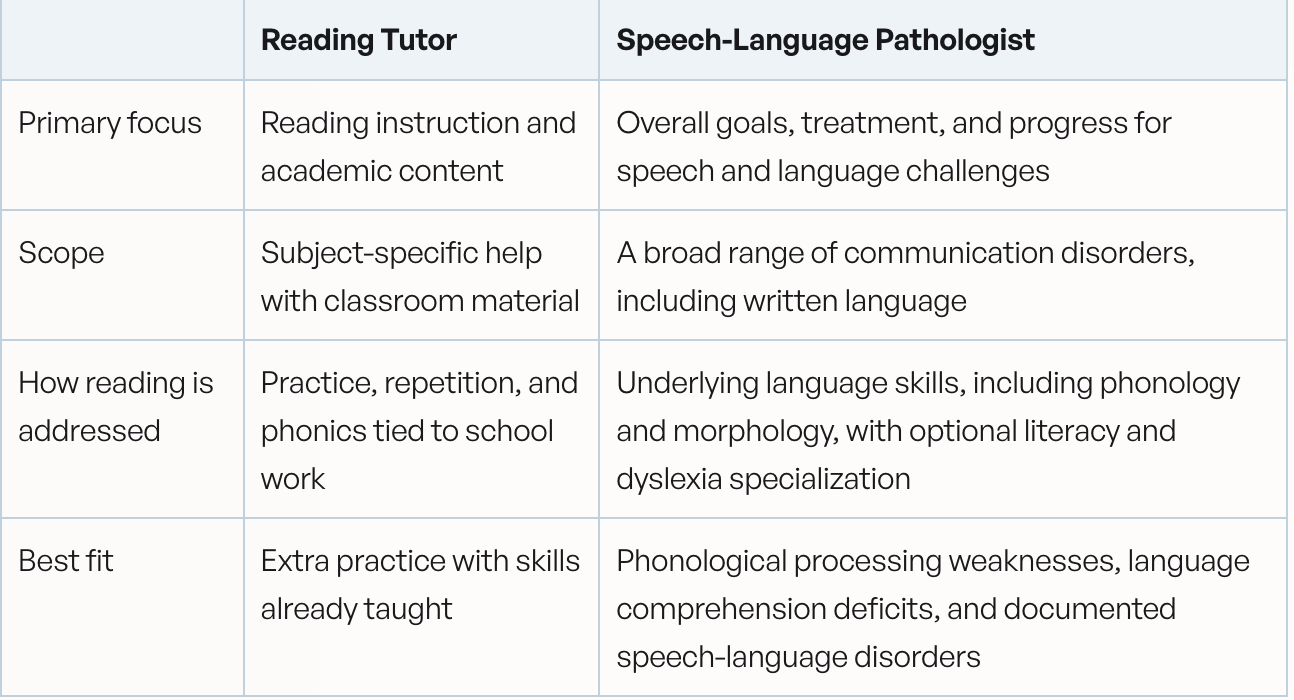
The table captures the core difference. A tutor helps a child keep up with school expectations. An SLP helps a child build the language skills that make reading possible in the first place.
When a Tutor Is the Right Fit
Tutors are ideal when a child needs extra practice or reinforcement of skills they have already been taught. The key is that the content is not new. If your child has learned a reading strategy in school but needs more time and repetition to master it, a tutor can give them that opportunity.
Tutoring can also be helpful for homework and study skills. When the goal is to keep up with school assignments and build confidence with familiar material, a tutor is a practical source of support.
When an SLP Is the Right Fit
Choose a speech-language pathologist when reading difficulty is driven by phonological processing weaknesses, language comprehension deficits, or a documented speech-language disorder. This is especially true for dyslexia and mixed reading profiles, where children show challenges in more than one area of reading at the same time.
Structured literacy intervention helps remediate reading difficulties at the source. Instead of repeating a lesson the child has already heard, the SLP targets the language processes that make the lesson hard to learn. SLPs concentrate on the overall goals, treatment, and progress of a student with speech and language challenges. That level of clinical focus is what sets them apart from a tutor who provides subject-specific help.

How a Language-Based Approach Works
At COIYA Literacy & Language Therapy, reading support is built on a language-based approach. Founder Maiya Coilton and the team provide one-on-one literacy, language, and dyslexia therapy for children ages 5 to 14. The practice combines Orton-Gillingham methodology with the POSSUM framework, giving children structured, explicit instruction that follows how the brain learns language. The practice also provides literacy disorder assessment and treatment, as well as dyslexia and language evaluations.
Families in Washington, DC and Northern Virginia can attend sessions in person, and virtual therapy is available as well. A language-based approach treats reading as part of a larger language system. That is exactly what many struggling readers need, and it is the reason an SLP can offer more than a tutor when language is the root cause.
Can an SLP and a Tutor Work Together?
The choice does not always have to be one or the other. Many families use SLP intervention to build foundational language skills while a tutor supports classroom assignments. The key is aligning the two approaches.
When the tutor knows what the SLP is targeting, homework help can reinforce therapy goals instead of working against them. This kind of team approach gives children both remediation and practical school support. If you are considering both professionals, look for providers who are willing to communicate with each other and with your child's school.

How COIYA Uses a Language-Based Approach
At COIYA Literacy & Language Therapy, the SLP or tutor for reading question is answered by looking at each child's language profile. COIYA is a pediatric speech-language pathology practice in Washington, DC and Northern Virginia that provides one-on-one literacy, language, and dyslexia therapy for children ages 5 to 14. The practice was founded by Maiya Coilton and uses a language-based approach to reading intervention, including the Science of Reading, Orton-Gillingham methodology and the POSSUM framework.
COIYA works with families who are frustrated with traditional tutoring results and are looking for a deeper explanation for their child's reading, writing, spelling, or language comprehension struggles. Services are offered in person and virtually, so families in DC, Virginia, and California can access support from home. Each session is grounded in the understanding that reading grows out of language.
Questions to Ask When Deciding
Start by asking what your child actually struggles with. Do they understand the lesson but forget it by the next day? That pattern suggests a tutor's repetition may help. Do they struggle to hear the sounds in words, understand what they read, or express their ideas? Those patterns point to language.
Ask your child's school or pediatrician about a language or literacy evaluation. An evaluation can reveal whether a speech-language disorder or dyslexia is behind the reading struggle. That information makes the SLP vs tutor for reading decision much clearer and helps you choose support that truly fits.
Frequently Asked Questions
Here are common questions parents ask when deciding between an SLP and a reading tutor.
-
Reading tutors focus primarily on reading instruction and reinforce skills already taught in the classroom. Speech-language pathologists have a broader scope: they address communication disorders and the underlying language skills that make learning possible. A tutor teaches academic content, while an SLP provides therapy targeting phonology, morphology, comprehension, and related areas.
-
Yes. Many SLPs receive additional training in reading, spelling, and writing to specialize in literacy and dyslexia. Their work goes beyond re-teaching lessons by targeting the phonological processing weaknesses and language comprehension deficits that drive reading difficulties. Choose an SLP when dyslexia or a mixed reading profile is present, since structured literacy intervention helps remediate the difficulty at its source.
-
Choose a reading tutor when your child needs more practice with classroom material and study skills. Choose a speech-language pathologist when reading difficulty is driven by phonological processing weaknesses, language comprehension deficits, or a documented speech-language disorder. If you are unsure, an evaluation by a qualified specialist can help you identify the root cause before you decide.
-
Yes. Many families use SLP intervention to build foundational language skills while a tutor supports classroom assignments. The key is aligning the two approaches. When the tutor reinforces the skills the SLP targets, your child gets both remediation and practical academic support. Communication between the professionals helps keep everyone focused on the same goals.
Outside DC, Virginia, or California? My therapy services are limited to my licensed states, but I offer that same approach as virtual Literacy Coaching to families anywhere in the U.S. If you want that kind of support for your child's reading, let's talk. Contact us to learn more!